Can Jürgen Klopp revive the German national team?
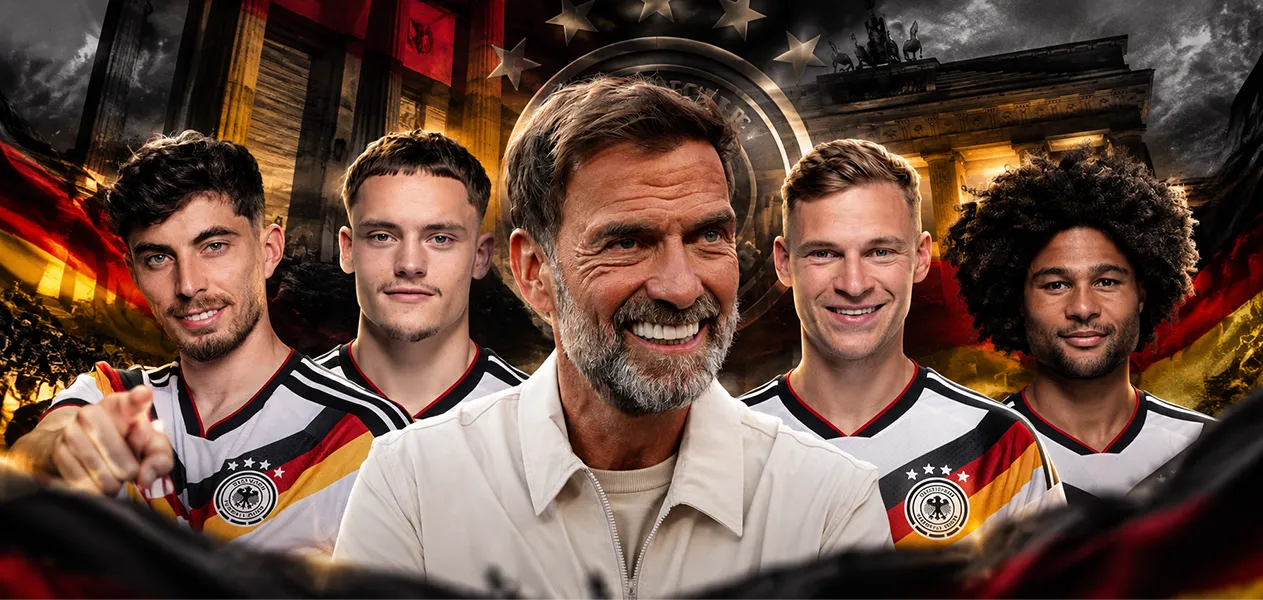
Former Liverpool and Borussia Dortmund manager Jürgen Klopp begins a new chapter as the head coach of the German men’s national football team, having taken over from Julian Nagelsmann on a four-year deal.
It is safe to say that the four-time World Cup winners have lost their way a bit. It has been more than a decade since they became world champions. Their performances in show-piece events after 2014 have been abysmal. At the 2018 and 2022 World Cups, they failed to qualify for the knockouts. In the latest edition, they were upset by Paraguay in the round of 32.
Having gone into the tournament with a top-quality squad and the tag of one of the favourites to go all the way, Germany’s underwhelming performances forced head coach Julian Nagelsmann to resign from his position.
There were a lot of rumours floating around Nagelsmann’s successor. With Klopp having left club football coaching in 2024 after departing from Liverpool, he seemed like the perfect choice. Klopp had been working with Red Bull as the Head of Global Soccer since January 2025. He said he was “running out of energy” while announcing his decision to leave Liverpool, as club football is a relentless round-the-year job that takes a lot out of a coach both physically and mentally. This made the national team coaching stint even more appealing, as the schedule isn’t as challenging, although the pressure can just as much, if not more.
Now we come to the big question: can Klopp revive the German national team and transform them into potential world champions?
Jürgen Klopp has an impressive resumé and has worked at some top clubs in his career. At Liverpool, the pressure on him was particularly immense, as the Reds hadn’t won the league title in almost three decades. He went on to transform an average team into world-beaters with his famed heavy-metal style of football that the world watched in awe and disbelief.
With the help of the club’s recruitment team, he built the squad with talented and hungry players and played an incredible brand of football, going toe-to-toe with Pep Guardiola’s fabulous Manchester City team. He not only won major silverware in his nine-year stint at Anfield, but also developed and turned potential top talents like Mohamed Salah, Virgil van Dijk, and Trent Alexander-Arnold into world-class players.
Even at Mainz and Borussia Dortmund he performed miracles, the latter of whom he turned into a pressing machine that clinched two back-to-back Bundesliga titles in the face of eternal pressure from Bayern Munich. He also led them to a Champions League final, where Bayern exacted their revenge by beating them in the final.
Unlike a lot of other coaches, Klopp has always been known to be eccentric in his coaching style. He already started putting a lot of groundwork ahead of the long international break. Usually, head coaches attend league matches to watch players, but Klopp decided to veer away from that trend, instead visiting the training sessions to understand their training regimes, styles, and intensity.
The first international break of the season is longer this time around and will see four games played over a three-week period. Staying true to his style, Klopp has announced two squads (featuring 22 players each) instead of one, with the first squad to play the first two games and the second, the next two.
Klopp hasn’t just managed to include a lot of players, thereby ensuring workload management, he’s also made them feel valued and wanted. In doing so, he has motivated his players and provided them with an opportunity to impress him while reducing chances of injury. Stiff competition and improved fitness always lead to better performances.
There are many young players in the Germany squad who have a lot of potential but haven’t performed up to their level yet: players like Florian Wirtz, Jamal Musiala, Lennart Karl, Tom Bischof, Said El Mala, and Younes Ebnoutalib, to name a few. These players have a golden opportunity to learn from one of the best in the business.
As Klopp starts his tenure with the DFB-Team, patience will be necessary. Expecting instant results would be unfair, as he needs time and games to analyse players, see how they form connections, find out the best possible combination, and then implement his style of play. That will take time, as the international window is a short one and players are mostly away playing club football. However, having seen his impact at Dortmund and Liverpool firsthand, I’ve no doubt that Klopp is the right man for the job.
He has the know-how, man-management skills, and motivation to perform at the biggest stages. He knows what it means to work in a high-pressure environment and succeed. Hence, the Germany job won’t faze him a lot.
Klopp has unreal aura and presence. He doesn’t mince his words. He is straightforward and honest, but he is also fiercely loyal. He may let his feelings be known in private, but he always backs his players and takes accountability for poor performances. All these traits, coupled with his vision of playing exceptional and dominant football, make him a coach par excellence.
Hiring Klopp as the German men’s national team head coach may prove to be a masterstroke by the DFB in the coming years. This appointment has come at the opportune moment, with the Euros just two years away. This could also serve as a warning for the other nations to gear up, as one can clearly imagine Germany playing aggressive, front-footed football and winning trophies in the not-so-distant future.